

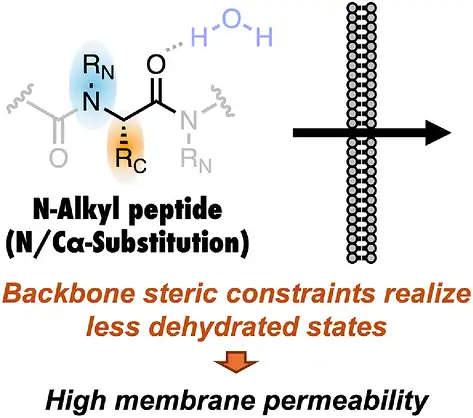
A paper led by the Sando Laboratory (Department of Chemistry and Biotechnology, The University of Tokyo), with our lab’s Masatake Sugita as a co-author, has been published in the open-access journal Angewandte Chemie International Edition.
N-alkyl peptides have emerged as promising drug modalities, yet the structural determinants governing their passive membrane permeability beyond amide hydrogen removal remained poorly understood. This study shows that N-alkyl peptides with sterically constrained backbones, generated by dual substitution at the amide nitrogen and the α-carbon, exhibit enhanced membrane permeability across a broad range of lipophilicity and diverse sequences. Molecular dynamics (MD) simulations revealed two cooperative mechanisms underlying this effect: conformational restriction that favors less hydrated states, and steric limitation of backbone hydration by β-carbons during membrane permeation.
Ayumi Inayoshi, Mariko Akiba, Marin Yokomine, Masatake Sugita, Koji Umezawa, Yuto Hirota, Yutaka Akiyama, Jumpei Morimoto, Shinsuke Sando, "Backbone Steric Constraints Underlie High Passive Membrane Permeability of N-Alkyl Peptides", Angewandte Chemie International Edition, 2026/8. DOI: 10.1002/anie.3948218 (advance online publication)
(translated by Claude)